Fractional laser skin resurfacing with the Er:YAG 2940 nm laser — powerful, non-surgical rejuvenation, scar smoothing and improved skin structure, with fast recovery. At Velvet Skin Clinic in Warsaw.
Laser skin resurfacing with the Fotona platform is one of the most advanced and effective methods of non-surgical, powerful skin rejuvenation and lifting. The treatment works by controlled laser-induced injury to the skin to vaporise tissue and stimulate fibroblasts to produce new collagen and elastin during the skin's regeneration and renewal process. The advantage of a fractional laser is its highly precise, fully controlled effect on the skin in the form of thousands of micro-injuries surrounded by healthy skin, which lets the skin heal quickly and the patient return to daily activity in a short time.
The laser settings can be tailored to every skin type (Fitzpatrick phototype) and patient age, which makes the treatment suitable for all patients and all indications linked to skin ageing or damage: wrinkles, furrows, pigmentation, loss of firmness, uneven texture or acne scars. The result of resurfacing is significantly rejuvenated, firmer and tighter skin with an even texture and tone.
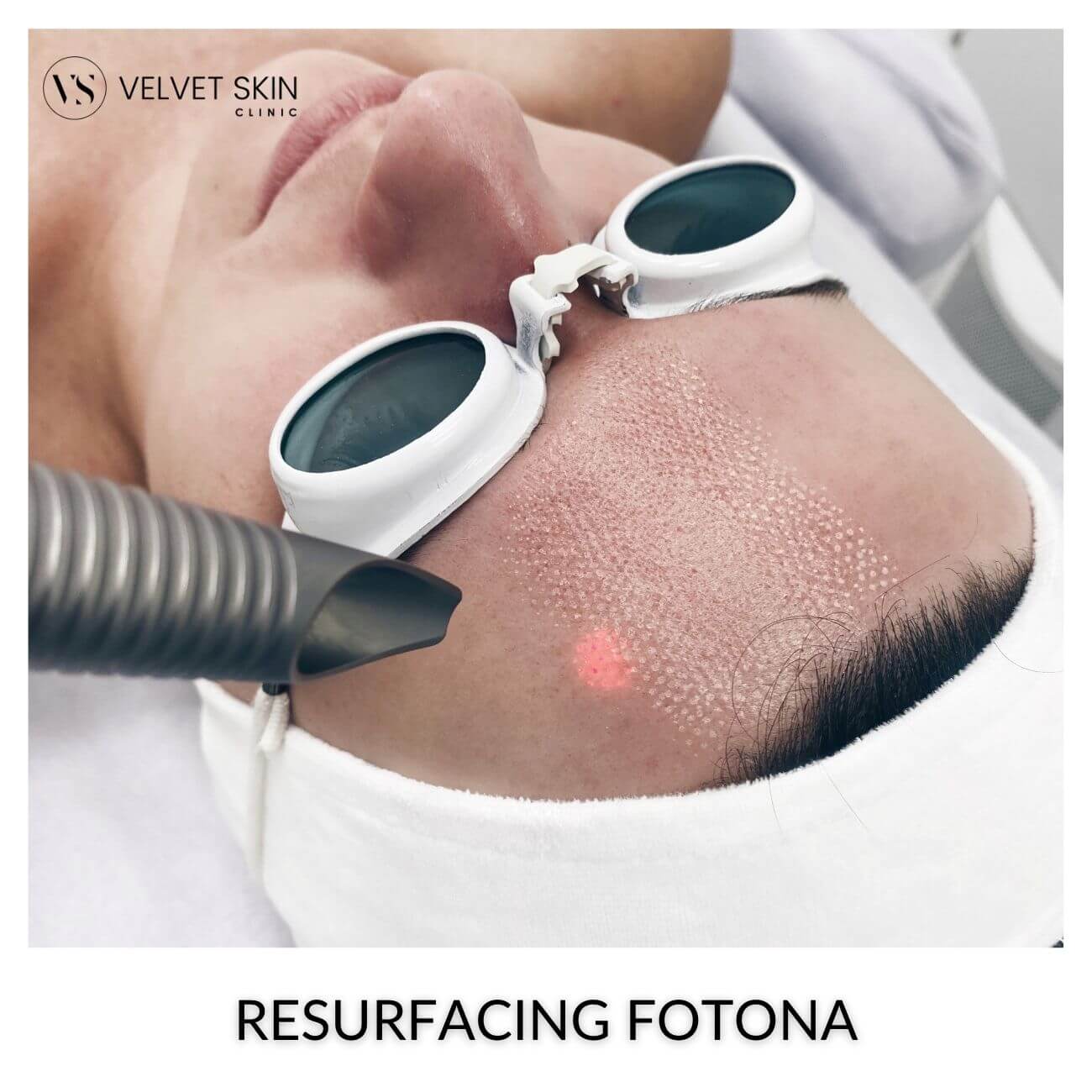
The resurfacing treatment at Velvet Skin Clinic uses the Fotona laser with an Er:YAG fractional handpiece at a wavelength of 2940 nm. With every pulse, the laser beam directed at the skin's surface produces anywhere from several dozen to several hundred tiny beams of energy that vaporise the epidermis and heat the dermis — creating thousands of controlled micro-injuries in the skin, known as “microchannels”. These channels are surrounded by healthy skin that was not exposed to the laser light, which lets the skin heal very quickly — new collagen and elastin are produced at the site of the channels, and the damaged tissue is replaced with new, healthy skin. This fractional system therefore delivers fast recovery and a quick return to daily activity.
Fotona laser resurfacing can be performed on almost any area of the body, although the treatment is most often used on the face, neck, décolletage, chest, hands, scars and stretch marks.
Fractional resurfacing belongs to the family of Fotona laser treatments we have offered since 2014 — the resurfacing-specific figure comes from matching records by treatment name.
Source: Versum and Booksy reports, as of 30.06.2026.
With every pulse, the Er:YAG 2940 nm handpiece produces anywhere from several dozen to several hundred beams of energy — thousands of “microchannels” that vaporise the epidermis and heat the dermis.
The channels are surrounded by intact skin that acts as a reservoir for fast healing — the key to the short recovery time of fractional treatment.
New collagen and elastin form at the site of the channels; the micro-injuries are replaced with new, healthy skin with an even texture and tone.
We most often perform this treatment on the face, neck, décolletage, chest and hands, as well as on scars and stretch marks on the body.
We use this treatment for 2 indications. It works a little differently for each one — below we explain exactly what it does in each case.
Fractional resurfacing rebuilds the skin more deeply than any of these treatments — for depressed and “ice pick” scars, it is usually the only method that delivers a visible change. In exchange, it requires a few days of recovery and sun avoidance.
02Resurfacing treats the entire area around the scar, blending it with the surrounding skin. We use it when a scar is extensive or when the skin around it also needs rebuilding.
Not sure which indication matches your situation? See all indications or ask us at a consultation.
Below are peer-reviewed publications on fractional Er:YAG laser resurfacing (PubMed).
The study assessed the efficacy and safety of a multifractional Er:YAG 2940 nm laser in treating acne scars, analysing improvement after successive sessions.
Cenk H, Saraç G, Dermatol Ther 2020;33(6):e14270. PubMed →A comparative study demonstrated the efficacy of fractional Er:YAG resurfacing in treating acne scars against 20% trichloroacetic acid.
Jangir VK et al., J Cutan Aesthet Surg 2023;16(4):319–324. PubMed →This review paper summarises the development and efficacy of fractional laser resurfacing, including fractional Er:YAG lasers.
Carniol PJ et al., JAMA Facial Plast Surg 2015;17(5):360–366. PubMed →The studies above concern the fractional Er:YAG technology on which Fotona resurfacing is based; the Cenk and Saraç paper refers directly to the 2940 nm laser. The number of sessions and the result depend on the skin's condition and needs — a course of 3–6 sessions gives the best results. Individual results may vary.
The laser itself works for approx. 15 minutes (the full visit takes about 60 min). For optimal, lasting results we recommend a course of 3–5 (up to 6) sessions every 4–8 weeks — each session builds on the results of the last. Treatments are not performed during periods of strong sun exposure.
A detailed health assessment and a check for contraindications.
The fractional handpiece works for about 15 minutes; the skin is cooled with the Cryo6 device.
Redness and swelling; after about 4 days the epidermis begins to peel gently.
Every 4–8 weeks; full fibre regeneration takes 3–6 months.
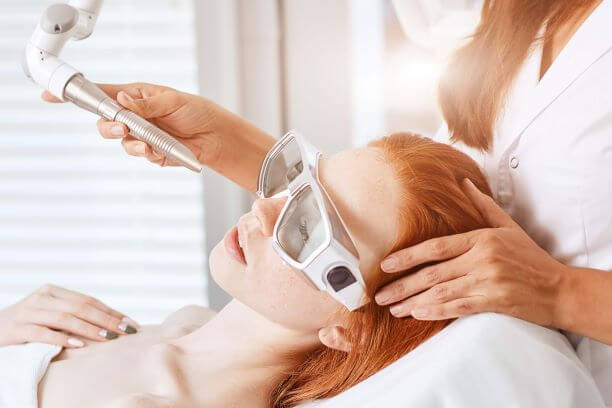
The treatment begins with a detailed health assessment of the patient and a check for any contraindications. The treatment itself involves directing the Er:YAG handpiece of the Fotona laser at the chosen area of skin to create a network of micro-injuries. The laser itself works for about 15 minutes. The treatment is noticeable, so the skin is cooled throughout with the medical Cryo6 cooling device.
Immediately after the treatment, the skin may be very red and irritated. Mild swelling may appear, which fades within a few hours. Redness starts to subside as early as the second day and clears completely after around 2–3 days. After about 4 days, the epidermis darkens slightly and then peels away in very fine flakes. Patients are advised to set aside a minimum of 2–3 days off their usual activity after the treatment, while the total post-treatment recovery takes about 7 days.
The first results are visible as early as a week after the treatment, once the peeling phase has passed. The complexion becomes radiant, the skin's texture smoother and its tone more even. Over the following 3–6 months, collagen and elastin fibres continue to regenerate, since that is how long full regeneration takes. The final result is a lifting effect and increased skin tautness, softened visible wrinkles, and a reduction in acne scars and skin irregularities.
The first treatment results are visible within a few days. To achieve optimal, lasting results, we recommend a course consisting of, depending on the patient's skin condition and needs, 3–5 sessions performed every 4–8 weeks. Each subsequent session builds on the results of the last. Treatments should not be performed during periods of strong sun exposure.
Authentic material from our Velvet Skin Clinic locations in Warsaw (Świętokrzyska — City Centre, Niepodległości — Mokotów).


The price depends on the treatment area and the number of sessions; a course of sessions gives the best results. You'll find the full price list on a separate page, and we'll work out the cost of your course at a consultation.
Resurfacing can be one stage of a more complex laser therapy, or the final step that completes a full treatment course — for example alongside Fotona 4D, Frac3 photorejuvenation, PIANO lifting or scar therapy. A specialist puts together the full therapy plan at a consultation.
A comprehensive laser facelift combining 4 Er:YAG and Nd:YAG treatments — for when you want lifting and tightening as well as skin structure improvement.
See Fotona 4DA dedicated Fotona laser therapy for acne, post-traumatic and surgical scars.
See scar therapyLaser therapy for sun-induced, post-inflammatory and hormonal pigmentation, and an even skin tone.
See pigmentation therapy„ClearLift Alma Harmony XL Pro is a great anti-ageing treatment. I can see a difference in how my skin looks. (translated from Polish)”
Aleksandra Pietryga · 2024Google review„As always, I'm happy with my visit. I recommend Ms Edyta — I always feel comfortable with her. (translated from Polish)”
Paulina · 2025Booksy review„Professional cosmetology at the highest level. As after every one of my visits, I fully recommend it. (translated from Polish)”
Karolina · 2026Booksy reviewWe assess every case individually during the consultation. The main absolute contraindications are:
Oral retinoid therapy (wait 6 months); recent tanning — sun/sunbed (4 weeks), self-tanners (2–3 weeks); medications (tetracyclines, sulfonamides) and photosensitising herbs (4 weeks); aesthetic medicine treatments, laser treatments, chemical peels (4 weeks); creams with retinol, vitamin A, AHA/BHA acids (2–3 weeks); active cold sores and skin infections, inflammatory/allergic conditions in the treatment area (2 weeks after healing); steroid and antibiotic therapy (2 weeks after completion); blood-thinning medication, high doses of vitamin A and E (1 week); fever and weakened immunity.
6 months before — finish any oral retinoid therapy. 4 weeks before — no tanning, antibiotics or photosensitising medication/herbs, no aesthetic medicine treatments or chemical peels, no creams with retinol or AHA/BHA acids. 3 days — stop aspirin and blood-thinning medication. 1 week — no enzymatic or micro-grain peels. If prone to cold sores — Heviran 2 days before and 3 days after. 24 hours — no alcohol. At all times — good hydration and UV protection.
A minimum of 4 weeks with no tanning, plus UV protection (SPF 50+). For 5 days, avoid strenuous exercise, saunas and anything that dilates blood vessels. Skin peeling is normal and expected; for strong irritation (scabbing) use a topical antibiotic. For 3–5 days avoid make-up if the skin is irritated (then mineral cosmetics only). Gentle cleansing (Cetaphil) and soothing creams (Avene Cicalfate, Alantan); avoid soap, surgical spirit, alcohol-based toners and peels. After the course — a follow-up visit about 6 weeks after the last session.
It is a fractional Er:YAG 2940 nm laser treatment that creates thousands of microchannels in the skin, surrounded by healthy tissue. It vaporises damaged epidermis and stimulates fibroblasts to produce new collagen and elastin — delivering powerful, non-surgical rejuvenation and a more even skin structure.
The treatment is noticeable, which is why the skin is cooled throughout with the medical Cryo6 device, significantly reducing discomfort. The laser itself works for about 15 minutes. Afterwards, the skin is red and irritated, which is a natural reaction.
For optimal, lasting results we recommend a course of 3–5 (up to 6) sessions performed every 4–8 weeks. Each session builds on the results of the last. The specialist determines the number of sessions based on the patient's skin condition and needs.
Redness fades after 2–3 days, and after about 4 days the epidermis begins to peel gently. We recommend setting aside a minimum of 2–3 days off your usual activity; full recovery takes about 7 days. For a minimum of 4 weeks, the skin should be protected from the sun (SPF 50+).
The first results are visible as early as a week after the treatment, once the peeling phase has passed — the complexion becomes radiant and the texture smoother. Full regeneration of collagen and elastin fibres takes 3–6 months, so the lifting and smoothing effect keeps building over time.
Yes. The fractional Er:YAG laser rebuilds the skin around the scar, evening out its surface and structure. Resurfacing reduces acne, post-traumatic and surgical scars. Peer-reviewed studies confirm the efficacy of fractional Er:YAG 2940 nm in treating acne scars.
Fotona laser resurfacing can be performed on almost any area of the body. We most often use it on the face, neck, décolletage, chest and hands, as well as on scars and stretch marks. Laser settings are adjusted to the area and skin type.
Yes. Resurfacing evens out skin tone and reduces sun-induced, post-inflammatory and hormonal pigmentation by renewing the epidermis and the skin overall. For more pronounced pigmentation, we often combine it with a dedicated laser pigmentation therapy.
Treatments are not performed during periods of strong sun exposure. Contraindications include pregnancy and breastfeeding, recent tanning, retinoid therapy, active skin infections, autoimmune conditions, a tendency to keloid scarring, cancer, and other conditions that rule out laser therapy. We assess every case at the consultation.
The price of resurfacing at Velvet Skin Clinic starts from 250 zł and depends on the area and number of sessions. A course of 3–6 sessions gives the best results. We'll work out the full price list and the cost of your course at the consultation.
Resurfacing is an ablative fractional Er:YAG laser treatment focused on skin structure — it smooths, rejuvenates and reduces scars. Fotona 4D is a comprehensive lift combining 4 Er:YAG and Nd:YAG treatments, including intraoral work, focused on tautness and lifting. We choose the right method for your goal at the consultation.
The treatment is performed by a doctor or an experienced cosmetologist. Every therapy is preceded by a health assessment and a check for contraindications, and the laser settings are chosen individually for the patient's skin type and age.
Treatments at Velvet Skin Clinic are performed by certified cosmetologists with years of experience in laser therapy, hi-tech devices and skincare treatments. After the consultation, we match the method and specialist to your skin and your goal.


00-116 Warszawa · opposite the Palace of Culture and Science
tel. 500 53 30 30
Publications underpinning this treatment — with PMID identifiers and an evidence-strength rating.